
India is a nation of contrasts and colours. I wanted to write about India as an experience, focusing on my time in Ranthambore where Great Rail Journeys' Golden Triangle holidays take two tiger-spotting safaris, one at sunrise and one at sunset.
For me, these are the most beautiful times of day in this extraordinary country, before daily life slows in the summer heat. Our journey from our hotel to and from Ranthambore National Park takes us along rural roads and through towns and villages.
India is a predominantly Hindu nation and this religion believes that humans and nature are inextricably linked, each depending on the other for survival. Consequently, urban and rural environments teem with plant and animal life, interlinked with human activity at every level. Animals are respected, fed and cared for by the entire community. Traditionally, Indian families will make morning chapatis for the family, with extras added for the local dogs and cows. Everything and everybody is at their most active during the cooler parts of the day, namely sunrise and sunset.
A dawn chorus with a difference
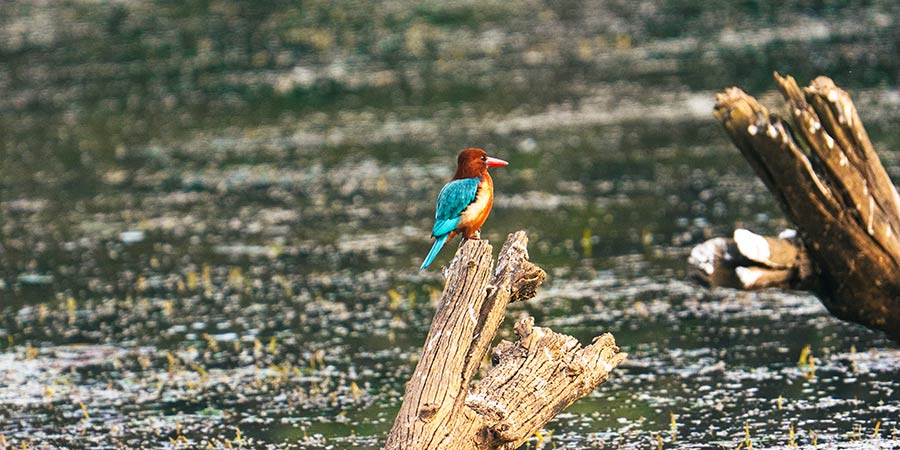
As the sun rises, vast flocks of multi-coloured birds rise up in an aerial ballet, seeking an insect breakfast, and providing a symphony of birdsong.
Parakeets, wagtails, lapwings, spoonbills, ducks and doves: the soundtrack of India is birdsong… and vehicle horns. In the first rays of the sun, monkey troupes become visible in the trees, grooming and foraging. The branches shake as they jump and swing and loose leaves cascade. The monkeys are either macaques or langurs and must be treated with respect for they are feral and intelligent. They will steal sunglasses and phones from the unwary and it is best not to carry food near them.
Two white wedding horses ride past, returning from the festivities of the night before or out for a morning stretch. Horses and riders tell the story of the previous night. Indian weddings are hugely important events, lasting days and costing a small fortune. After four days of celebration, all involved can become jaded.
A camel passes, pulling a wooden cart on car tyres. On top of the cart, a man is on his mobile phone. The camel knows where it is going, pulling the cart with that curious gait, as if in slow-motion, placing its feet carefully while keeping its head high, imperiously surveying the surrounding mêlée through two-inch-long eyelashes.
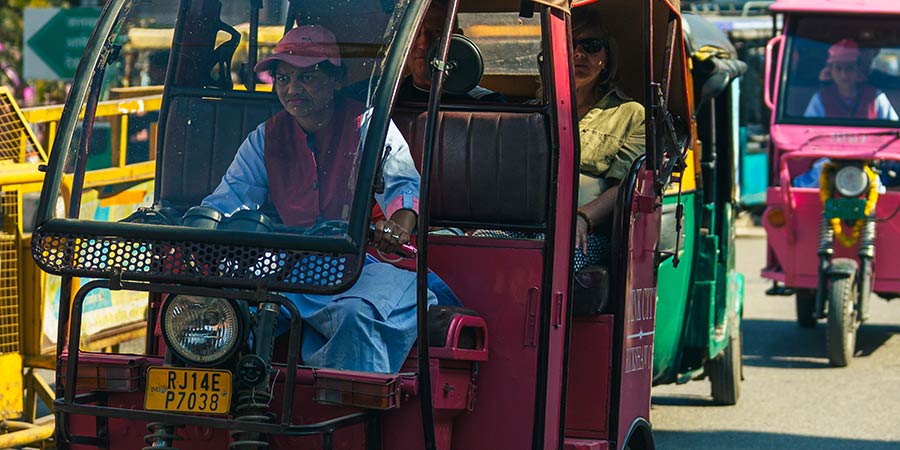
The colours of Indian roads
Our vehicle is surrounded by a constantly migrating shoal of tiny motorcycles. No helmets, mirrors, indicators or headlights, sometimes bearing four or more people, but usually a man driving with a sari-clad woman sitting side saddle on the rear. Her sari may be a bright saffron, lime green or vermillion and the colours sing in the Indian sunshine.
Some vehicles known as gugabs chug by. These are homemade and unlicensed. They use motors intended for use on village water pumps and have no bodywork except for a seat and steering column. You can hear every power stroke in each individual engine cylinder as they reach their top speed of about 10mph. Yellow and green tuk-tuks swim in and out of traffic streams. Designed to seat a maximum of four people, they regularly carry eight or more. Cargo and children are piled in together and brightly coloured sari material flaps in the slipstream.
Dogs are everywhere, usually sleeping or sitting while gazing hopefully at a street-food vendor. At sunrise, the dogs mount a morning inspection patrol of their territory, checking in with fellow pack members for a bark and a sniff, and then yawning and stretching before seeking a favourite shady spot ready for the heat of the day.
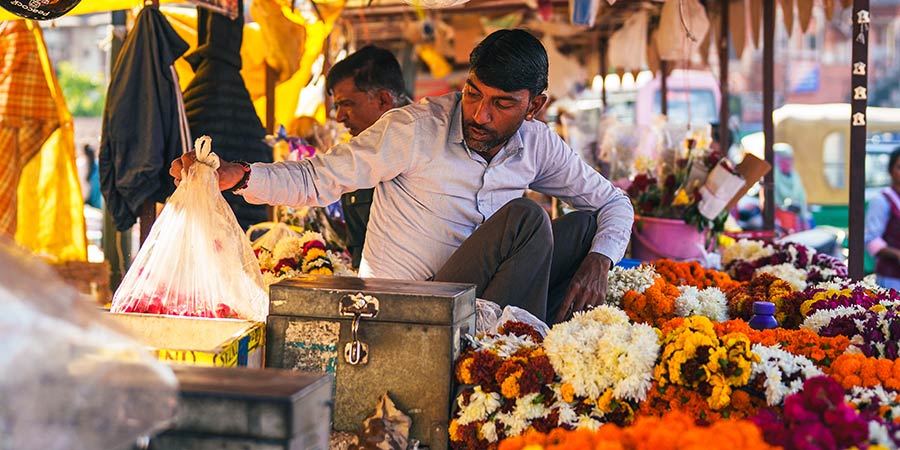
Bovines, bread and batsmen: Roadside sights
On the road ahead of us, two cows have decided to take a nap in the centre of the road, while a third stands on the concrete median, considering in which direction she might move. This is a lengthy process, and the traffic jam builds steadily in each direction as the mobile roadblock mulls over her options. A vehicle attempts to pull around the two lying down, but there is insufficient space between them and the roadside stall selling sugar cane juice. The space vacated by the vehicle has now, of course, been occupied by tuk-tuk and voices are raised at the inconvenience; the number of voices swelling as interested bystanders with little else to do add their own contributions. Eventually, one the cows is firmly but gently persuaded to move, and the traffic line begins to clear, slowly manoeuvring past the remaining bovine holdout, who is disinterested and unconcerned. She knows she is safe.
The food vendors are beginning to set up shop for the day ahead. Vegetables, fruit, sugar cane and the ever-present Indian bread makers are turning on stoves, laying out wares and filling the air with the fragrance of their produce.
The queue for the morning bus service has grown to an astonishing length and after negotiations, some passengers and their belongings are loaded on the roof.
Small children play cricket on a patch of dirt by the road. They wear no shoes. The wicket is an empty fruit packing crate, and the bat is a wooden strip pulled from that crate that can loft the ragged tennis ball to the theoretical boundary with ease; or else it can split. They play with huge enthusiasm and have learned by heart the mannerisms and gestures of their heroes in the Indian national team. Lofty disdain for a poorly bowled delivery and feigned outrage when an appeal for 'out' is not given. The game has finished on our return, but the children remain, running towards our vehicle waving, grinning, shouting a few cheeky words of English that they have picked up.
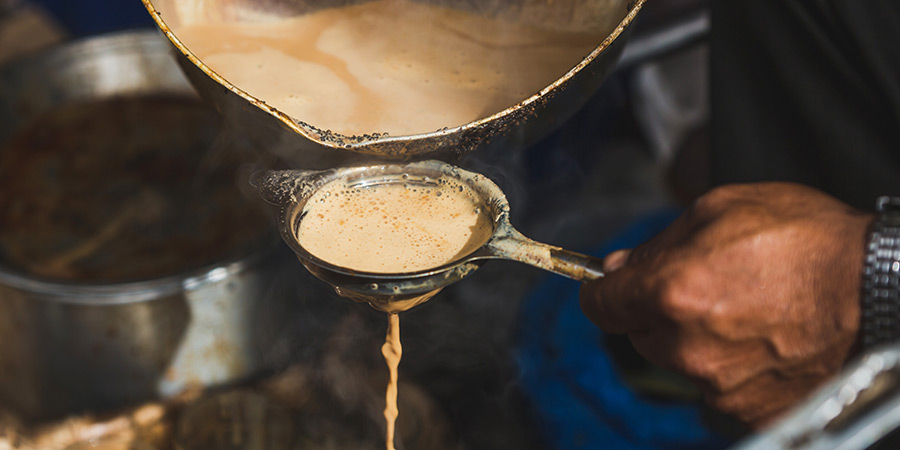
Chai: A taste of life on the road
The roadside chai stores selling hot, sweet, milky, spiced tea are doing a roaring trade. Men and women stand sipping, watched by two brown and white goats who are nibbling on a leafy branch tied to one of the wooden poles holding up the roof. The roof structure looks shaky enough as it is, without adding the structural threat of tethered goats. Nobody else seems worried by this, so I shrug and move on. Indian goats, as elsewhere, have a habit of turning up in unexpected and precarious places - standing on walls, roofs, temples, vehicles and everything, as the mood takes them.
India drinks chai often, but in small cups. These are frequently made from clay, like miniature terracotta flowerpots. Use once, throw in bin and the fragments are later collected and recycled into yet more clay teacups. I have to confess an addiction to c; I drink it at home daily. Every Indian housewife will tell you that they have the best spice mix for masala chai - some secret, magical ratio of tea, ginger, cardamom, pepper, cloves, cinnamon and more that is boiled in milk and passed through a strainer when served. If spiced tea sounds strange to you, think of a cup of Typhoo with a ginger biscuit on the side. Not so different.
In Shimla, I have drunk early morning chai with the drivers for the fleet of vehicles that convoy us around. Steam rose from the cups as we drank in the morning chill beneath an umbrella of Himalayan pines and cedar trees; in the distance the rising sun cast variegated colours on the mountains below the snow line.
I have drunk chai at a roadside dhaba (small cafe) with Indian Army officers and the driver of a grossly overloaded tuk-tuk carrying empty propane cylinders that seemed to glow in the heat of the sun. At our feet, chickens pecked and nearby lay the inevitable sleeping dog, too hot to chase chickens.
Wherever you go there will be a chaiwala, a man selling chai from a flask. Just look for locals sipping from cup and he will be somewhere in the vicinity.
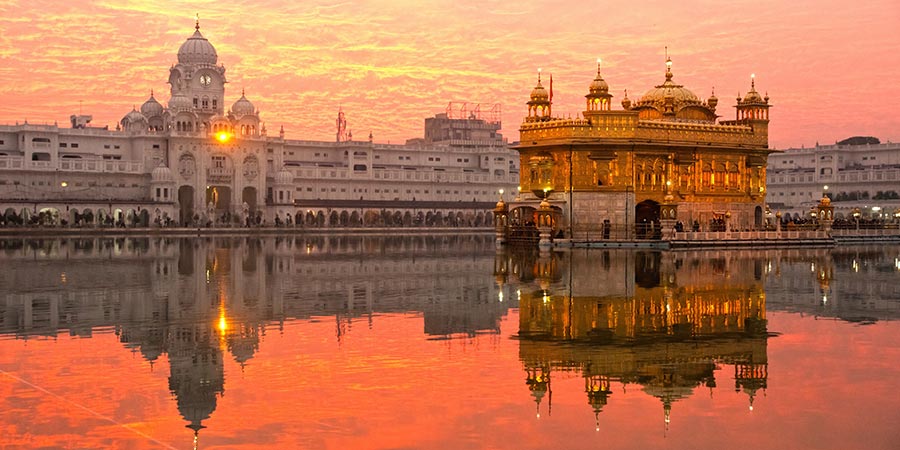
Discover India with the experts in escorted travel
Enjoy the unforgettable sights and sounds of India on our Golden Triangle holidays, escorted throughout by a Tour Manager and local guides.
Experience our bestselling long-haul holiday India's Golden Triangle, Tigers & Shimla, the only tour operator to combine the Golden Triangle with Shimla, the former summer capital of the British Raj.
You might also like:
- Discover India's Golden Triangle & Tigers
- The Maharajas' Express, Golden Temple & Shimla
- Find our full range of India tours here